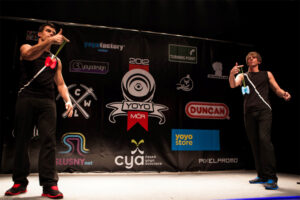
For much of its history, the yo-yo carried a familiar image: a childhood toy, a playground activity, or a simple skill challenge passed between generations.
But as players began experimenting with new techniques and personal styles, a different side of yo-yo culture emerged.
Away from traditional toy shelves and organized demonstrations, yo-yoing found new energy in creative communities where individuality, expression, and experimentation mattered more than following established rules.
Freestyle players transformed the yo-yo from a nostalgic pastime into a form of movement-based art. They brought it into streets, gatherings, online spaces, and performance scenes, creating a culture built around flow, originality, and personal expression.
The yo-yo did not disappear as a toy.
It evolved as a creative language.
Breaking Away From the Traditional Image
For decades, many people associated yo-yos with classic tricks and childhood memories.
The image was familiar:
- A child practicing simple movements
- A performer demonstrating traditional tricks
- A toy company promoting a new model
- A casual game between friends
While these traditions remained important, a new generation of players wanted to explore what else the yo-yo could become.
They asked different questions:
- What if tricks could become performances?
- What if movement mattered as much as difficulty?
- What if every player could develop a unique style?
This mindset created a shift from repetition to exploration.
The yo-yo became less about copying known techniques and more about creating something personal.
The Rise of Freestyle Communities

Freestyle culture grew from players who wanted more freedom.
Instead of focusing only on traditional trick lists, they experimented with combinations, transitions, and original movements.
These communities valued:
- Creativity
- Individual style
- Innovation
- Smooth execution
- Personal expression
Players began developing their own approaches to movement.
Some focused on technical complexity.
Others emphasized rhythm and visual flow.
Some created routines that felt closer to dance than traditional yo-yo demonstrations.
Freestyle gave players permission to define what yo-yoing meant for themselves.
The Meaning of Flow
One of the most important concepts in modern yo-yo culture is flow.
Flow describes the feeling of continuous movement where tricks connect naturally and the player appears to move effortlessly.
A routine with strong flow is not only impressive because of difficulty.
It is memorable because it feels intentional.
Flow comes from:
- Timing
- Smooth transitions
- Control
- Creativity
- Connection between movements
A player with flow does not simply perform tricks.
They create an experience.
The Influence of Street and Independent Culture
As freestyle developed, yo-yoing began sharing qualities with other creative subcultures.
Like skateboarding, breakdancing, and street art, modern yo-yo culture often emphasizes:
- Personal style
- Community recognition
- Creative experimentation
- Skill development
- Independent expression
Players gathered in informal spaces to practice, exchange ideas, and challenge each other.
The focus was not always on official recognition.
Sometimes it was simply about creating something new and sharing it with others.
This independent spirit helped redefine the public perception of yo-yoing.
The Yo-Yo as a Performance Object
A major change in modern yo-yo culture was the transformation of the yo-yo into a performance tool.
A freestyle routine combines elements of:
- Sport
- Dance
- Theater
- Music
- Visual art
The player becomes both athlete and performer.
A great routine requires more than technical ability. It requires understanding:
- How movement looks from an audience perspective
- How tricks connect emotionally
- How timing creates impact
- How personality influences performance
The yo-yo becomes an extension of the performer.
Creativity Over Competition

Although competitive yo-yoing has grown significantly, underground communities helped emphasize another important value: creativity.
Not every player is trying to win a championship.
Many play because they enjoy:
- Creating new tricks
- Exploring unusual movements
- Developing personal styles
- Sharing ideas
This creative approach keeps the hobby open and constantly evolving.
A beginner can contribute something new just as an experienced player can.
Innovation does not belong only to professionals.
The Role of Online Culture
The internet accelerated the growth of freestyle communities.
Players could now share performances instantly with audiences around the world.
Online platforms allowed:
- New tricks to spread quickly
- Players to discover different styles
- Communities to form across borders
- Independent creators to gain recognition
A player no longer needed to live near a major yo-yo scene to participate.
A bedroom practice session could become a global performance.
This accessibility helped create a new generation of creative players.
Equipment Designed for Expression
As freestyle developed, yo-yo design evolved alongside it.
Players needed equipment that supported new styles of play.
Modern freestyle yo-yos often prioritize:
- Stability
- Long spin times
- Smooth movement
- Precision control
- Advanced string techniques
Designers began working closely with players to create tools that expanded creative possibilities.
The relationship between player and equipment became part of the artistic process.
The yo-yo itself became a reflection of the player’s approach.
The Importance of Personal Identity
One of the strongest elements of freestyle culture is identity.
Players are recognized not only by what they can do but by how they do it.
Style can come from:
- Trick selection
- Movement speed
- Performance choices
- Creativity
- Visual presentation
Two players can perform similar techniques and create completely different experiences.
This individuality is what gives freestyle its artistic character.
The goal is not simply to master the yo-yo.
It is to develop a unique relationship with it.
Changing How the World Sees Yo-Yoing
The growth of freestyle communities changed the public image of the yo-yo.
It challenged the idea that the yo-yo was only a children’s toy.
Modern audiences began seeing it as:
- A creative discipline
- A performance art
- A competitive activity
- A global community
- A form of self-expression
The yo-yo became proof that ordinary objects can become extraordinary through human creativity.
The Future of Yo-Yo Flow Culture
The underground spirit of yo-yoing continues to influence its future.
New players continue experimenting with:
- New movements
- New performance styles
- New equipment designs
- New ways of sharing creativity
The culture remains open because there is no final version of yo-yoing.
Every player adds something.
Every generation changes the movement.
Every new trick expands the possibilities.
More Than a Toy, More Than a Sport
The journey of the yo-yo from playground object to creative subculture shows the power of imagination.
Freestyle communities did not abandon the history of the yo-yo. They expanded it.
They took a familiar object and discovered new ways to move, perform, and connect.
The modern yo-yo is not defined only by the tricks it can perform.
It is defined by the people who use it to create something original.
From street sessions to championship stages, from personal practice to global communities, the yo-yo continues to evolve through one simple idea:
Movement becomes art when someone adds their own style.
