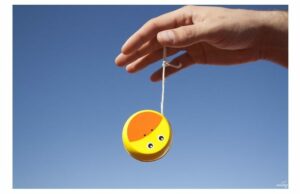
The Golden Age of the Yo-Yo: When America Fell in Love with Spinning Strings

Few toys have created a cultural moment quite like the yo-yo. At first glance, it was a simple object: two rounded halves connected by an axle, a string wrapped around the center, and a player using gravity, timing, and skill to bring it to life. Yet during the height of its popularity, the yo-yo became far more than a toy.

It became a national obsession.

Across America, children gathered in schoolyards to practice tricks, families watched demonstrations, companies built entire marketing campaigns around the excitement of spinning strings, and talented performers turned simple movements into unforgettable shows.

The golden age of the yo-yo was a time when a pocket-sized invention captured the imagination of millions and proved that a simple idea could become a powerful cultural phenomenon.

The Perfect Toy for a Changing America

The rise of the yo-yo came during a period when American culture was rapidly changing.

As mass production expanded and consumer products became more accessible, toys were no longer just handmade objects passed between generations. Companies began creating products designed for national audiences.

The yo-yo was perfectly suited for this new era.

It offered several advantages:

  • Affordable production
  • Easy transportation
  • Simple instructions
  • Endless opportunities for skill development
  • Strong visual appeal

Unlike many toys that required batteries, special equipment, or large spaces, the yo-yo could fit in a pocket and be played almost anywhere.

A child could begin with a simple up-and-down motion and gradually discover an entire world of tricks.

The Rise of Yo-Yo Companies and Big Branding

The golden age of the yo-yo was closely connected to the rise of professional toy companies that understood the power of branding.

Manufacturers realized they were not simply selling a product. They were selling excitement, identity, and participation in a larger movement.

Successful yo-yo brands focused on:

  • Eye-catching designs
  • Memorable names
  • Professional demonstrations
  • Trick instruction
  • Community events

The yo-yo became a product with a personality.

Instead of being just another toy on a shelf, it became something children wanted to collect, master, and show to others.

How Advertising Created a Yo-Yo Craze

Advertising played a major role in transforming the yo-yo from a simple toy into a cultural event.

Companies promoted yo-yos through energetic campaigns that emphasized action and skill.

Advertisements often featured:

  • Expert players performing impressive tricks
  • Excited children learning new techniques
  • Challenges and competitions
  • Messages about practice and improvement

The key idea was powerful:

Anyone could become a yo-yo expert with enough practice.

This message made the toy feel interactive and personal.

A yo-yo was not something you simply owned—it was something you developed a relationship with.

The Traveling Yo-Yo Demonstrator

One of the most important parts of the yo-yo’s popularity was the live demonstration.

Professional yo-yo performers traveled to schools, stores, fairs, and community events to showcase advanced tricks.

These demonstrations created excitement because audiences could see possibilities they never imagined.

A skilled performer could make a yo-yo:

  • Sleep at the end of the string
  • Travel through complex patterns
  • Perform dramatic movements
  • Appear to defy gravity

For many children, seeing an expert performer was the moment they realized the yo-yo was much more than a basic toy.

The demonstration created inspiration.

The practice created dedication.

The Schoolyard Became the Training Ground

The yo-yo’s popularity grew because it naturally became a social activity.

Children learned from each other by:

  • Sharing tricks
  • Creating challenges
  • Comparing skills
  • Teaching beginners
  • Showing off new techniques

The schoolyard became an informal training environment.

A child who mastered a new trick instantly became someone others wanted to learn from.

This social element helped the yo-yo spread faster than traditional advertising alone could achieve.

The toy created its own community.

The Birth of Yo-Yo Competition Culture

Competition helped transform casual play into a structured activity.

Yo-yo contests encouraged players to improve their skills and gave companies opportunities to create excitement around their products.

Competitions often included categories such as:

  • Trick difficulty
  • Creativity
  • Performance quality
  • Speed
  • Precision

These events gave young players a goal beyond personal improvement.

The yo-yo became a way to challenge others, earn recognition, and develop confidence.

The Yo-Yo as Entertainment

During its golden age, the yo-yo became closely connected with entertainment.

Performers brought energy and personality to their routines, turning tricks into shows.

The best demonstrations combined:

  • Technical skill
  • Humor
  • Storytelling
  • Audience interaction
  • Stage presence

This helped audiences see yo-yoing as a performance rather than just a hobby.

A talented player was not simply demonstrating a toy—they were creating an experience.

Why the Yo-Yo Captured American Imagination

The yo-yo succeeded because it represented something deeply appealing: the satisfaction of improvement.

Unlike many toys that provided entertainment immediately, the yo-yo rewarded effort.

A beginner experienced small victories:

  • Making the yo-yo return
  • Learning a first trick
  • Improving control
  • Creating new combinations

Each achievement created motivation to continue.

The toy offered a simple but powerful message:

Practice creates progress.

That idea connected with generations of children.

Design Innovation During the Yo-Yo Boom

The popularity of yo-yos also encouraged experimentation in design.

Manufacturers developed different styles, shapes, and materials to attract players.

Design changes focused on:

  • Better balance
  • Improved durability
  • More attractive appearances
  • Easier handling
  • Greater trick potential

The yo-yo became both a toy and a piece of design innovation.

Collectors began appreciating unique models, while players searched for designs that helped them perform better.

The Role of Nostalgia and Generational Connection

One reason the yo-yo has remained culturally important is its ability to connect generations.

Parents who played with yo-yos introduced them to their children.

Older players shared classic tricks with younger beginners.

The same basic object could create memories across decades.

The yo-yo became more than entertainment—it became a shared experience.

The End of the Golden Age and the Start of a New Era

Like many cultural trends, the first major yo-yo boom eventually faded.

New toys, changing entertainment habits, and evolving consumer interests shifted attention elsewhere.

However, the yo-yo never disappeared.

Instead, it transformed.

Modern players pushed the boundaries of what was possible, creating advanced freestyle performances, international competitions, and new communities built around creativity and technical skill.

The golden age created the foundation for the modern yo-yo movement.

The Legacy of the Yo-Yo Boom

The golden age of the yo-yo proved that a simple object could become a cultural force.

Through smart advertising, passionate performers, innovative companies, and enthusiastic communities, the yo-yo became one of America’s most recognizable toys.

Its success was not just about selling millions of units.

It was about creating a shared language of movement.

The yo-yo gave people a way to compete, create, connect, and express themselves. It showed that entertainment does not always require complicated technology—sometimes all it takes is a string, a spinning object, and the curiosity to see what is possible.

Decades later, the echoes of that golden age continue. Every new player who picks up a yo-yo and attempts their first trick becomes part of the same tradition that captured America’s imagination generations ago.